Predictive simulation for smarter drug delivery.
We build physics-informed AI software that reveals how nanoparticles and drugs move through tissues and across biological barriers — helping researchers design better formulations with fewer experiments.
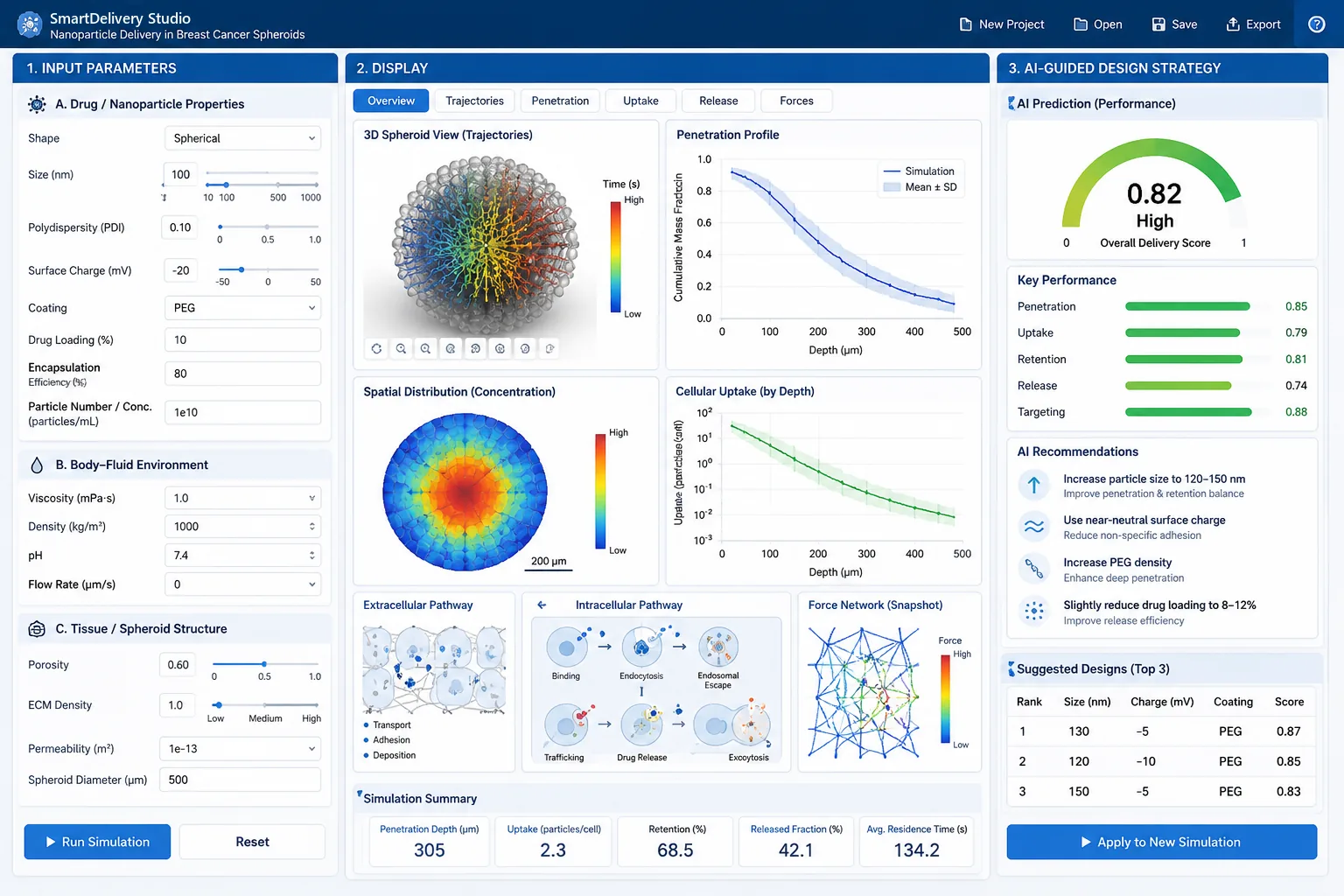
Smart Drug Delivery Computing is an Australian software company turning mechanistic modelling into practical tools for nanomedicine and drug delivery design.
Whether a drug reaches its target depends on processes that happen at scales experiments struggle to see — particle–cell and particle–matrix interactions, barrier crossing, retention, degradation and drug release. Our software makes these hidden mechanisms visible and quantitative.
Alongside our simulation platform, we offer custom software development, simulation services, scientific advice and computational consulting.
About usThe mechanisms that decide delivery success are hidden at the microscale.
Hidden mechanisms
Particle-scale interactions, local forces and mass transfer occur at spatial and temporal scales that conventional in vitro and in vivo experiments cannot resolve directly.
Limits of experiments
Animal studies are costly and raise ethical concerns, while organoids and organ-on-chip models still cannot measure key particle-scale information on their own.
AI without the right data
AI is powerful when relevant data exist — but the microscale transport data that matter most for nanomedicine design are largely missing.
Physics empowers AI. AI makes design predictive.
We use physics-based modelling to generate the missing microscale information, calibrate it against experimental and imaging data, then use AI to learn from it, generalise it and turn it into actionable design rules.
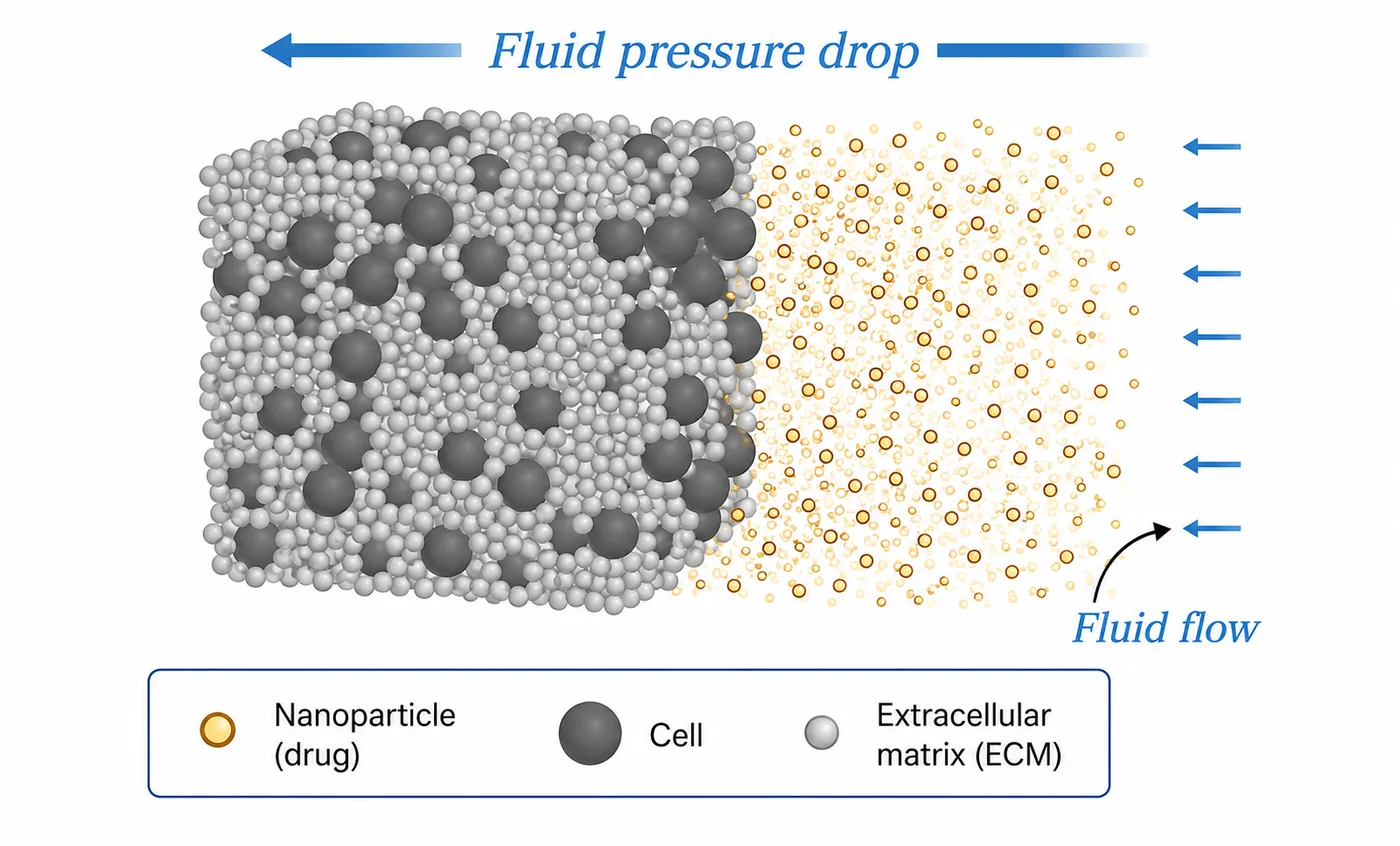
Mechanistic multiscale models
Particle-scale and multiscale models capture convection, diffusion, adhesion, aggregation, cellular uptake, barrier crossing, breakage, degradation and drug release.
Physics-informed AI
Physically consistent simulation data train surrogate and reduced-order models for rapid prediction, sensitivity analysis and uncertainty quantification.
Predictive design rules
Mechanisms become recommendations for particle size, charge, coating, stiffness, drug loading and release kinetics — before you go to the lab.
Software and expertise, end to end.
Use our platform yourself, or let our team build, run and interpret simulations for you.
Custom software
Tailored simulation tools, interfaces and workflows built around your formulation, tissue model and lab data.
Learn more →Simulation services
Send us your problem. We set up, run and analyse the cases and deliver clear, publication-ready results.
Learn more →Scientific advisory
Mechanism interpretation and model-guided advice on formulation design and experimental planning.
Learn more →Computational consulting
Expert support in multiscale modelling, model calibration and validation, and physics-informed AI.
Learn more →Built for drug delivery research.
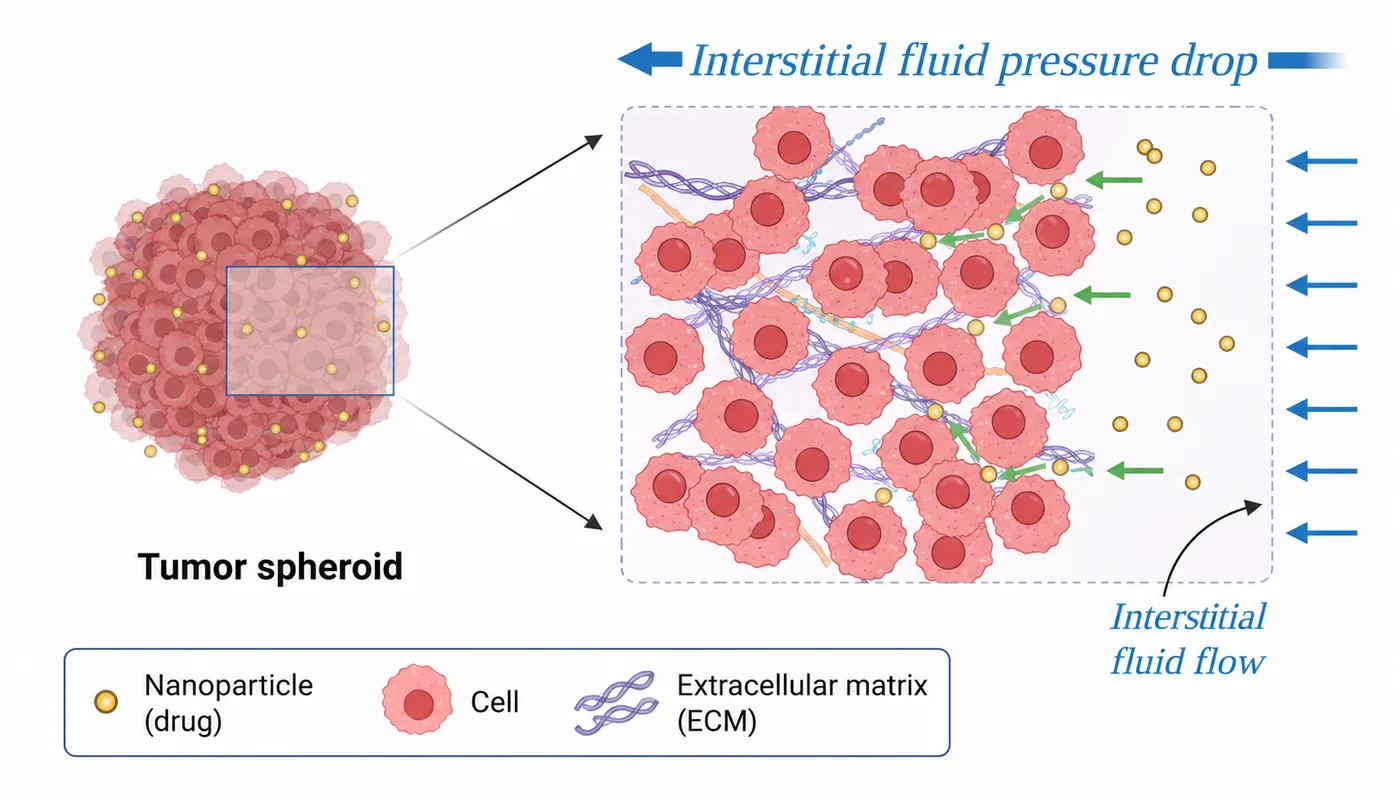
- Nanoparticle penetration and retention in tumour spheroids and organoids
- Transcellular vs paracellular transport across endothelial and epithelial barriers
- Drug release, degradation and mass transfer in tissue
- Formulation screening and optimisation before lab or animal testing
- Image-informed model calibration using microscopy and permeability data
Have a delivery problem to simulate?
Tell us about your formulation, tissue model or data. We’ll suggest the right approach — from a single study to a custom tool.